Views: 0 Author: Site Editor Publish Time: 2026-09-24 Origin: Site
A perfect fusion splice is physically impossible without a perfect cleave. In the telecommunications industry, field technicians often focus their procurement budgets heavily on high-end fusion splicers. They inadvertently treat the preparation tools as an afterthought. However, a poor cut inevitably leads to high insertion loss, severe signal reflection, and costly network rework. You cannot fix a bad glass break with a good splicer.
Global fiber optic networks continue to expand at a breakneck pace. This encompasses sprawling Fiber-to-the-Home deployments, dense 5G infrastructure, and hyperscale data centers. Consequently, the demand for reliable, high-precision fiber preparation tools has never been higher. The margin for error in modern single-mode networks is practically zero. To meet these rigorous standards, investing in a high-quality optical fiber cleaver is an absolute necessity for seamless network performance.
You need to know exactly what parameters matter in the field. We will break down operational types, analyze critical specifications, and help you choose the most appropriate device for your specific splicing applications, daily volume, and budget constraints.
Key Takeaways
Precision is Non-Negotiable: A professional-grade device must consistently deliver a cleave angle of less than 0.5 degrees. This facilitates optimal fusion splicing and minimal signal loss.
Match the Tool to the Task: High-precision benchtop models are mandatory for fusion splicing. Simpler mechanical tools only suffice for temporary mechanical repairs.
Automation Saves Time: One-step devices significantly reduce fiber preparation time. They mitigate operator error compared to traditional multi-step models.
Blade Life Matters: Technicians should prioritize equipment featuring multi-position, rotatable tungsten steel blades. These should offer between 36,000 and 48,000 operations before requiring complete replacement.
An optical fiber cleaver is a specialized, highly calibrated precision instrument. It is used to score and snap a silica glass optical fiber. The objective is not to cut the fiber in the traditional sense, much like shearing a copper wire with pliers. Instead, the tool introduces a microscopic flaw known as the score. It then applies highly controlled tension until the glass breaks cleanly. This delicate process must create a perfectly flat end-face strictly perpendicular to the longitudinal axis of the fiber.
The cost of a bad cleave is substantial. Microscopic imperfections prevent the fusion splicer from aligning the fiber cores correctly. Watch out for lips, hackles, chips, or angled cuts. When the splicer attempts to fuse an imperfect end-face, it traps air bubbles or creates misalignments. This causes severe light scattering. This translates directly to high insertion loss and poor return loss.
Recent industry trends highlight a massive shift in network architecture. Telecommunications providers are rapidly migrating to 400G and 800G high-speed networks. What does this mean for field technicians? Optical loss budgets are shrinking to practically zero. Legacy preparation tools are now the primary bottleneck in advanced deployments. You cannot pass stringent optical time-domain reflectometer diagnostic testing with a subpar cut. Utilizing a premium device is no longer just a luxury. It is a critical requirement.
From a financial perspective, purchasing a premium fiber preparation tool is a direct investment in operational efficiency. Budget-friendly options might seem appealing initially. Yet, they often result in hidden expenses. These include wasted splice protection sleeves, ruined lengths of expensive cable, and increased labor time per splice. The worst-case scenario is repeat truck rolls to fix failed splices in the field. Reliable equipment ensures technicians execute their tasks flawlessly on the first attempt.
Understanding the distinction between tool categories is the first step in making an informed purchasing decision. The market is divided into two main segments based on internal mechanics and intended use.
Often referred to as stapler-style tools, mechanical cleavers are basic devices. They are used primarily for mechanical splicing, quick field terminations, or temporary emergency repairs. They rely heavily on the manual force of the user to score and break the fiber. Their primary advantage is a low upfront cost and a highly portable nature. However, they carry a significantly higher margin of error. They produce inconsistent end-face angles that frequently exceed 1.0 degree. Because of this unpredictability, they are entirely unsuitable for modern fusion splicing where strict loss budgets are enforced.
In contrast, precision models are heavy-duty units designed specifically to accompany core-alignment and cladding-alignment fusion splicers. They utilize engineered internal mechanisms to control the scoring depth and snapping tension automatically. Although they require a higher initial capital investment, a precision optical fiber cleaver guarantees sub-0.5-degree angles. This unwavering consistency is absolutely essential for low-loss single-mode fiber splicing in long-haul and high-speed data networks.
Feature | Mechanical Cleaver | Precision Cleaver |
|---|---|---|
Average Cleave Angle | 0.8 to 1.5 degrees | Less than 0.5 degrees |
Operating Mechanism | Manual tension and scoring | Automated, calibrated tension |
Primary Application | Emergency repairs, mechanical splices | Core-alignment fusion splicing |
Scrap Collection | Usually manual or non-existent | Automatic offcut bins |
Blade Lifespan | Low to Moderate | High up to 48,000+ operations |
Selecting the right equipment requires evaluating several technical specifications beyond just the price tag. Stop guessing which tool will work. Use these critical factors to assess the long-term viability and field performance of your chosen tool.
The defining metric of any preparation device is its angle accuracy. For a fusion splicer to seamlessly melt two fibers together without trapping air bubbles, the end-faces must be perfectly flat. Industry standards dictate that the angle must be strictly less than 0.5 degrees. High-end precision tools consistently achieve angles between 0.3 and 0.5 degrees. If the angle exceeds this threshold, the cameras inside the fusion splicer will detect the flaw. The machine will pause the operation and throw an error code, which bottlenecks your entire workflow.
The scoring blade serves as the heart of the tool. Premium blades are manufactured from tungsten steel or tungsten carbide. These materials are renowned for their extreme hardness and resistance to wear. Silica glass is incredibly tough, meaning even the best blade will eventually dull. To maximize lifespan, look for blades that feature 16 to 24 distinct, numbered positions. Professional devices also allow for vertical height adjustments. A 16-position blade with 3 height levels yields up to 48,000 precise operations before needing a replacement. This drastically lowers the total cost of ownership.
Workflow efficiency is vital when technicians splice hundreds of strands a day. Traditional multi-step models require the operator to load the fiber, manually slide the blade carriage backward to score the glass, and then press an anvil down to snap it. Conversely, a one-step optical fiber cleaver automates this entire sequence. The user simply places the fiber in the holder and presses the top cover down. The internal mechanics automatically score the fiber, apply the snapping tension, and push the hazardous glass scrap into a collection bin in one fluid motion. This drastically reduces operator fatigue and minimizes human error.
Your daily project requirements dictate the type of fiber holder you need. Technicians deploying outdoor networks usually require a universal fiber holder. This holder must secure 250μm bare fiber, 900μm pigtails, and 3mm drop cables without requiring the user to swap out fragile adapter plates. On the other hand, professionals working in high-density backbone environments frequently handle ribbon cables containing up to 12 fibers fused together. These specific applications demand a device designed to accommodate mass-fusion ribbon chucks.
Safety should never be overlooked on the job site. Cleaving produces microscopic shards of silica glass. These shards are virtually invisible, incredibly sharp, and pose a severe health hazard if they embed into the skin or eyes. A professional-grade unit must include an automatic scrap collection system. As the fiber is snapped, a mechanical roller or static sweeper safely deposits the hazardous offcut into a secure, enclosed bin. This maintains a clean workspace in compliance with occupational safety standards.
Fieldwork is inherently harsh. Equipment is frequently dropped from aerial buckets, bounced around in service trucks, and exposed to freezing mud or extreme heat. A reliable device should be constructed from CNC-machined aluminum or heavy-duty metal alloys rather than brittle plastics. Modern high-end units feature shock-absorbing rubberized drop-proof casings. This ensures the delicate internal alignment remains calibrated even after accidental impacts.
Different networking environments demand different tool profiles. Aligning your purchase with your specific daily applications ensures maximum efficiency and a solid return on investment. Do not overspend on features you do not need, but never compromise on core accuracy.
Technicians deploying fiber to residential areas operate in unpredictable, fast-paced outdoor environments. The primary needs here are rugged durability, portability, and universal fiber holders. The ability to seamlessly transition from standard bare fibers to thick 3mm outdoor drop cables without hunting for spare parts saves immense time. A robust, shock-resistant one-step device is the ideal companion for this sector.
In hyperscale data centers, speed and mass termination are the absolute priorities. Technicians frequently splice 144-strand or 288-strand trunks. The equipment selected for this environment must support mass ribbon holders. Extreme precision is under the microscope here. A single bad score on a 12-fiber ribbon means the entire ribbon must be stripped, cleaned, and re-cleaved. This causes massive project delays.
Finding a balance between cost and reliability is paramount for contractors managing strict capital limits. Beginners should steer clear of ultra-cheap mechanical stapler tools if they intend to perform fusion splicing. Instead, target entry-level precision benchtop models. These provide the necessary sub-0.5-degree accuracy and feature easily replaceable parts. They offer a strong baseline of performance as your technical skills develop.
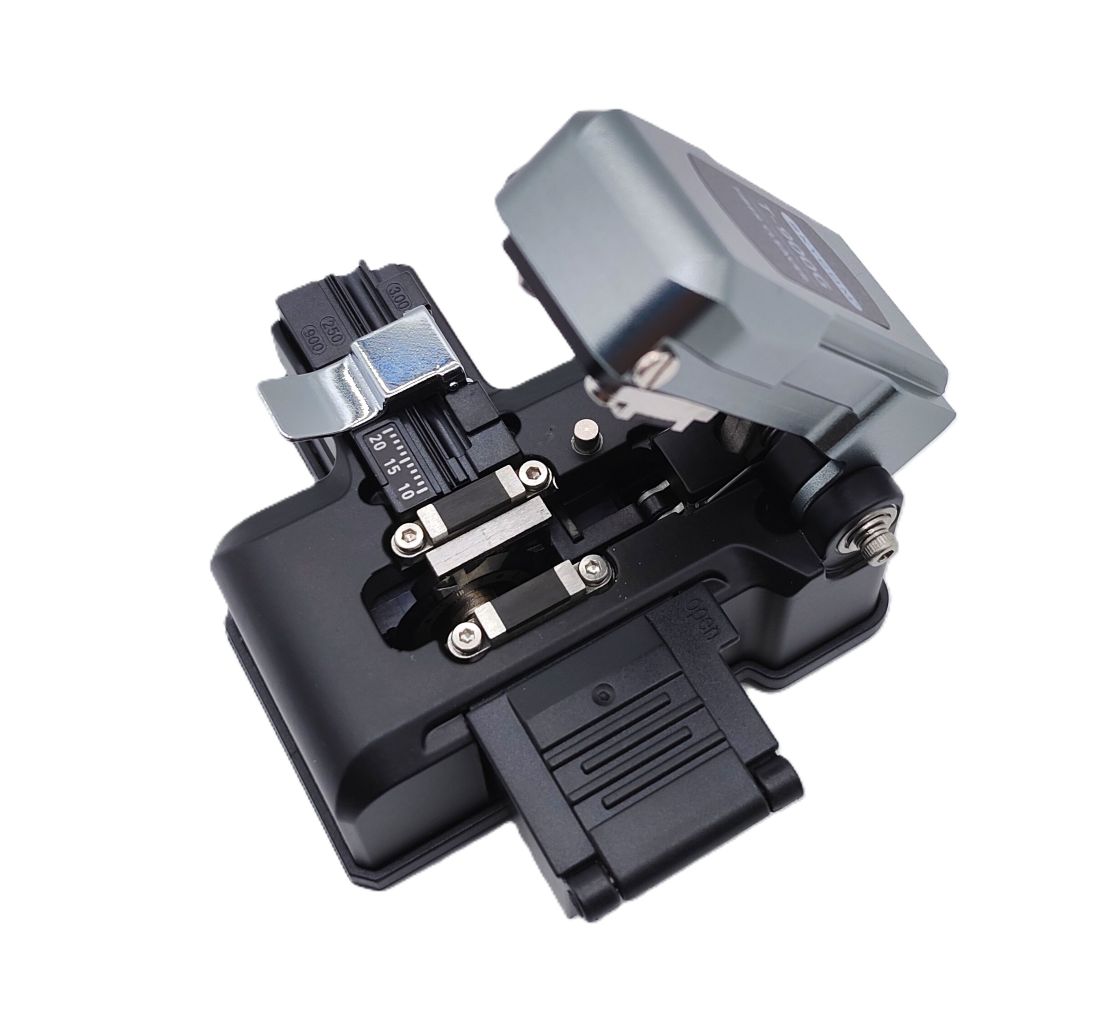
When evaluating the market for a solution that perfectly balances advanced automation, rugged durability, and cost-effectiveness, certain models clearly stand out. For network professionals seeking a reliable daily driver, the SKYCOM T-900G optical fiber cleaver represents a top-tier choice tailored specifically for modern field operations.
The SKYCOM T-900G is engineered to eliminate the common, frustrating pain points associated with fiber preparation. It bridges the gap between laboratory-grade precision and field-ready toughness by integrating advanced CNC machining with an intuitive interface. It is designed for technicians who demand consistent, low-loss splices without being bogged down by complex preparation procedures.
Specifically, the T-900G boasts true one-step operation. With a single downward press of the cover, the device automatically completes the scoring of the glass, the snapping of the fiber, and the safe collection of the scrap shard. This automated motion minimizes human error and ensures uniform tension on every cut.
Beyond just the mechanics, it is equipped with a premium tungsten steel blade that consistently delivers superior angles of less than 0.5 degrees. The blade features 16 rotational positions and 3 height adjustments. This provides a remarkable lifespan of up to 48,000 operations before a replacement is necessary. Built to withstand the realities of outdoor deployment, its robust metal chassis is highly resistant to shocks and drops. Finally, the inclusion of a highly adaptable universal holder allows technicians to securely grip bare fiber, pigtails, and standard drop cables without swapping proprietary jigs.
Even the most expensive, highly calibrated precision tool will fail if it is not properly maintained. Silica glass dust, ambient moisture, and environmental debris can quickly degrade performance. This directly leads to a spike in splice failures.
Routine maintenance should ideally be performed at the end of every shift. Always use 99 percent pure isopropyl alcohol. Lower concentrations contain water, which can leave a hazy residue or cause internal metal components to oxidize. Use a lint-free swab dipped in alcohol to gently wipe away glass dust and oils from the top and bottom rubber gripping pads. If these pads are dirty, the fiber will slip during the tension phase. This results in a severely angled break. Very carefully run a dry lint-free swab along the edge of the blade to remove microscopic glass shards. Never use hard or metallic objects to scrape the blade.
A dull blade is easily diagnosed in the field. Your fusion splicer screen will repeatedly display angled errors. Alternatively, you might notice the fiber simply bending and crushing instead of snapping with that satisfying, crisp click. When this occurs, do not attempt to force the tool to work. Use the provided hex key to loosen the blade locking screw. Carefully rotate the blade to the next numbered position, such as moving from position 1 to position 2, and retighten the screw securely. Documenting this rotation in your maintenance log helps you track exactly how much life remains on the current blade.
For fusion splicing, the angle must be strictly less than 0.5 degrees to prevent insertion loss and ensure the cameras inside the splicer can align the cores properly. For mechanical splicing or fast field connectors, an angle of up to 1.0 degree is generally acceptable. However, achieving a lower angle is always better for long-term network stability.
A standard high-quality tungsten steel blade typically features 16 to 24 rotational positions. If each position provides 1,000 to 2,000 cuts factoring in multiple vertical height adjustments, a single blade can easily last for 36,000 to 48,000 total operations before needing a complete replacement.
A two-step model requires the user to manually slide the blade carriage forward to score the glass, and then press a separate anvil down to snap the fiber. A one-step model simplifies this entirely. It performs the scoring, snapping, and automatic scrap collection in a single downward press of the lid. This saves valuable time and drastically reduces the chance of user-induced errors.
Uneven breaks, lips, or shattered end-faces usually point to three common issues. First, the blade may be dull and needs to be rotated to the next position. Second, the rubber gripping pads might be dirty with skin oils or glass dust, causing the fiber to slip during the snap. Third, the blade height might be set too high, causing it to crush the fiber rather than scoring it delicately.
No. Standard drugstore rubbing alcohol usually contains 30 percent water and added oils. The water content will leave a residue on the rubber pads and can cause the internal metal components of your tool to rust. Always use 99 percent pure laboratory-grade isopropyl alcohol combined with lint-free swabs for maintenance.
No. These blades are precision-machined at a microscopic level from extremely hard materials like tungsten carbide or tungsten steel. Attempting to sharpen them with standard grinding tools or whetstones will completely destroy the microscopic cutting edge. Once all rotational positions and height adjustments have been exhausted, you must replace the blade entirely.
Stop letting poor cleaves ruin your splice loss budgets and delay your network deployments. Evaluate your current daily volume and project requirements, then upgrade to a tool built specifically for the harsh realities of the field. Visit SKYCOM today to explore reliable, high-precision fiber preparation solutions tailored to your exact needs, ensuring every splice is perfect on the first attempt.