Views: 0 Author: Site Editor Publish Time: 2026-04-01 Origin: Site
A Fiber Tester is used to check more than whether a fiber link simply has light. In real field work, technicians may need to verify signal presence, continuity, optical power, insertion loss, live-fiber status, or PON service conditions depending on the network and the job stage. That is why many buyers feel uncertain at first: they know they need to test fiber, but they are not always sure what should actually be measured. Understanding what a fiber tester can test helps users choose more suitable tools and avoid inefficient purchases. As an experienced optical fiber device supplier, Nanjing SKYCOM Communications Ltd develops practical fiber maintenance solutions that support installation, inspection, and service work worldwide.
One common misunderstanding in fiber optic cable testing is the idea that one quick reading can describe the whole link. In practice, different tests answer different questions. One tool may confirm signal presence, another may measure power, and another may help identify a live fiber without interrupting service. In some cases, the job also requires loss testing or PON signal verification.
That is why fiber testing should be seen as a process. A link can show light and still perform poorly. It can pass a basic continuity check and still have too much attenuation for stable service. For buyers, this is an important point: what a fiber tester tests depends on the tool type and the field purpose.
A simple yes-or-no result is useful, but it is not always enough. A cable that carries light may still have dirty connectors, weak power, or excessive loss. A quick visible check may help with early troubleshooting, but it does not replace a more meaningful measurement when link quality matters.
This is why different test results should not be confused with one another. Signal presence, power level, and loss all describe different parts of network condition. The more clearly a buyer understands that difference, the easier it becomes to choose the right tool.
Yes, signal presence is one of the most basic things a fiber tester can check. During installation, technicians often need to confirm that light is reaching the far end of the fiber and that the connection path is complete. This is especially useful after patching, splicing, or termination.
That kind of check is valuable because it quickly tells the team whether the link is active at a basic level. It helps remove guesswork before the next step of testing begins.
Fiber testers can also help with continuity checks and simple fault indication. In many field situations, the first question is not about advanced diagnosis. It is simply whether the path is open or interrupted. A visual fault locator is often useful here because it can reveal obvious breaks, bends, or leakage points in accessible fiber sections.
Still, this kind of check has limits. It is helpful for fast inspection, but it does not replace optical loss measurement or deeper troubleshooting. It should be treated as a practical early-stage test, not a full judgment of link quality.
Optical power tells the technician how much signal is reaching the receiving side of the link. In simple terms, it shows whether the signal is strong enough for the system to operate as expected. If the power is too low, the receiver may not perform reliably.
That makes optical power measurement useful during installation, service checks, and maintenance. It turns a visual assumption into a measurable result and helps the technician judge real link condition more clearly.
Insertion loss shows how much signal is lost as light travels through the fiber link. This is one of the most meaningful test results because it reflects the condition of the cable path, connectors, and splices.
A link can have signal present and still fail to meet expectations if insertion loss is too high. That is why loss testing is often more valuable than a simple continuity check when the goal is reliable service. For many buyers, this is also the point where the difference between tool categories becomes much clearer.
In active networks, touching the wrong fiber can interrupt service. That is why live-fiber identification is so important in cabinets, patch panels, and dense cable environments. A tester designed for this task allows technicians to check whether a line is active without disconnecting it.
This helps reduce service risk and makes maintenance work safer and more efficient. For teams working around live traffic, this function can be more important than basic continuity alone.
In most cases, the technician wants quick answers to practical questions. Is the fiber live or dark? Which line in the group is carrying signal? What is the signal direction? These answers help avoid mistakes during field repair and service work.
A fiber identifier is especially useful in these situations because it supports non-intrusive checking and faster decision-making on site.
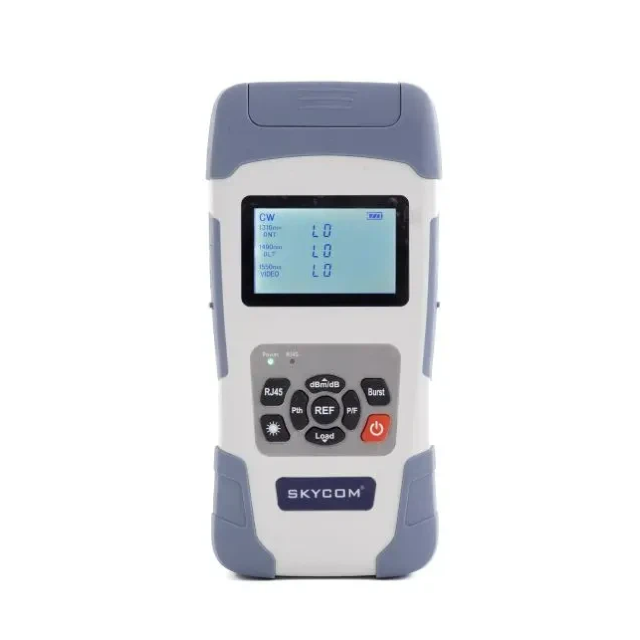
PON networks are different from standard point-to-point fiber links. They involve specific wavelengths and service conditions, so testing should match that environment. A general check may not be enough when the work involves FTTH installation or access-network maintenance.
This is why PON testing should be treated as a separate field requirement rather than just another version of basic signal checking.
A PON field test helps verify whether the service-side optical signal is present and whether upstream and downstream conditions look normal. This is useful during installation, activation, maintenance, and service troubleshooting.
For buyers, the key message is simple: network type affects test needs. A tool that works well for general fiber verification may not be the best choice for PON service work.
A fiber tester is highly useful, but it cannot do every job by itself. When the task requires detailed event mapping or long-distance fault location, an OTDR is usually the more suitable tool. Basic testers support routine verification and practical field checks, while deeper diagnosis needs more advanced equipment.
This is important because unrealistic expectations often lead users to choose the wrong product for the job.
What a fiber tester tests should define the purchase, not just the product name. If the job is basic signal verification, a simpler tool may be enough. If it involves loss measurement, live-fiber checking, or PON service work, the shortlist should reflect that.
A better purchase starts with a better definition of the testing target.
Test Target | What It Means | Recommended Tool | Typical Field Scenario | Basic or Advanced |
Signal Presence | Confirms light in the fiber | Optical light source or basic tester | New link check | Basic |
Continuity | Verifies path completion | Visual fault locator | Patching and inspection | Basic |
Optical Power | Measures signal strength | Optical power meter | Service verification | Basic to mid-level |
Insertion Loss | Shows total link signal loss | Optical power meter plus light source | Installation acceptance | Mid-level |
Live Fiber Status | Identifies active or dark fiber | Fiber identifier | Active network maintenance | Mid-level |
PON Signal Check | Verifies PON service conditions | PON power meter | FTTH service work | Mid-level |
Detailed Fault Analysis | Maps link events and faults | OTDR | Deep troubleshooting | Advanced |
The most practical way to select a tester is to begin with the test question. Do you need to verify continuity, measure loss, identify a live fiber, or check a PON line? Once the question is clear, the tool category becomes much easier to narrow down.
That approach is better than searching for one broad device and expecting it to do everything well.
Shortlisting becomes easier when buyers compare products by job purpose. Installers may focus on power and loss testing. Maintenance teams may value live-fiber identification and fast fault checks. PON technicians may need service-specific measurement tools.
A fiber optic tester is not defined by one simple reading. It supports a range of checks that help users understand signal condition, link quality, live-fiber status, and network-specific performance more clearly. Nanjing SKYCOM Communications Ltd provides practical testing solutions for installation, maintenance, and service verification across different fiber applications. If you want to find the right tool for your testing needs, contact us to learn more about SKYCOM’s fiber maintenance products.
In many field jobs, the first test is signal presence or continuity, because technicians need to know whether the link is active before moving to deeper checks.
Yes. Optical power is measured with a power meter, while insertion loss is usually checked with a power meter and light source together.
Yes, but only certain tools can do that. A fiber identifier is commonly used to check live fiber without disconnecting the line.
No. It is excellent for practical field checks, but deeper diagnosis such as long-distance fault mapping usually requires an OTDR.


