Views: 0 Author: Site Editor Publish Time: 2026-04-03 Origin: Site
A Fiber Tester is only useful when it fits the actual job. That is why smart buyers do not simply look for the most advanced model. They look for the right function, the right network fit, and the right level of testing for daily work. A contractor, FTTH installer, ISP technician, and maintenance team may all search for the same product term, but what they need can be very different. Some need quick field checks, while others need power measurement, loss testing, live-fiber detection, or PON verification. As a professional optical fiber device supplier, Nanjing SKYCOM Communications Ltd provides practical fiber maintenance solutions that help users match testing tools to real application needs.
The first step is to define where the tester will be used. A tool chosen for new installation is not always the best one for maintenance. During deployment, users usually need to verify the link, measure performance, and confirm that the line is ready for service. In that stage, accurate readings and clear results matter most.
Maintenance work is different. A field technician often needs speed, convenience, and fast problem isolation. In many cases, the goal is to check signal status, identify a live fiber, or confirm whether the link still works after a repair. That makes the work stage one of the most important factors in selection.
Some jobs only need a basic answer. Is the fiber path complete? Is light present? Is there an obvious visible fault? In these cases, a simpler tester may be enough.
Other jobs require deeper validation. If the goal is to measure optical power or insertion loss, the tester should provide real measurement capability instead of a simple pass-or-fail result. Buyers who understand this difference usually make better purchasing decisions.
A fiber tester should match the network it will serve. Singlemode and multimode systems do not always require the same support, and wavelength compatibility also matters. If the tester does not fit the fiber type or operating wavelength, the results may be less useful for real work.
Buyers do not need to overcomplicate this step, but they should understand the basic network condition before selecting a model.
The network environment also changes which features matter most. In PON or FTTH work, service-specific measurement is often more important, so a PON power meter may be the right fit. In enterprise or general maintenance work, portability, connector flexibility, and clear readings may matter more.
This is why the same product keyword can lead to different tool choices. The best tester depends on where it will actually be used.
If the main need is to measure signal strength or evaluate insertion loss, an optical power meter and optical light source are often the most practical starting point. This combination is widely used for installation, acceptance testing, and maintenance verification.
These tools are useful because they provide measurable results instead of basic confirmation only. That makes them more suitable when network quality must be clearly evaluated.
Not every user needs measurement first. In many service situations, speed matters more. A visual fault locator is useful for quickly spotting visible breaks, bends, or leakage points. It is simple, portable, and well suited to first-line inspection.
A fiber identifier is designed for a different task. It helps users detect live fiber without disconnecting service. For technicians working in active networks, this function can be especially valuable.
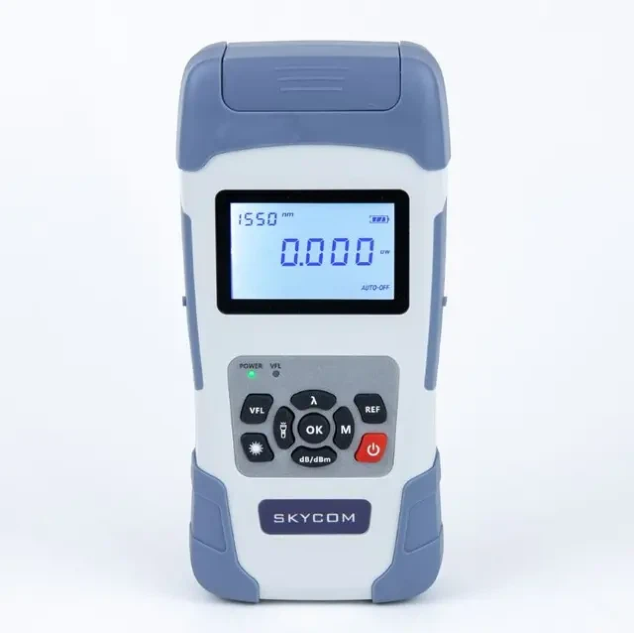
After deciding the main function, buyers should compare practical features. Connector compatibility matters because the tester must work smoothly with the existing fiber environment. A clear display also matters because field results need to be read quickly and confidently.
Operation speed is another practical factor. A tester that is slow to set up or use may reduce efficiency during repeated site work.
Fiber testing equipment is often carried from site to site and used repeatedly throughout the day. That makes portability and durability important. A compact handheld design is easier to manage, and a sturdy housing is better for daily field use.
Simple controls and stable operation also help reduce user error. In real work, convenience often has a direct effect on productivity.
Many users already work with fusion splicers, OTDR units, and other maintenance devices. A fiber tester does not need to replace them, but it should fit smoothly into the same workflow. A tool that supports daily verification and works well with existing equipment is usually a better long-term choice.
Some teams start with one tester and add more tools later. That is often the most practical path. A buyer may begin with a power meter or visual fault locator, then later add a fiber identifier or PON power meter as work expands.
Planning for future use helps avoid repeated replacement and protects the budget over time.
Price is important, but it should not be the only deciding factor. A low-cost tester that does not fit the application can lead to repeat work, slower troubleshooting, and limited value in the field.
A lower price only makes sense when the tool still supports the job properly.
Another common mistake is treating the term “fiber tester” as though it means one universal device. In reality, different tools are designed for different purposes. Some are better for measurement, while others are better for quick checks, live-fiber work, or PON service.
Understanding that difference helps buyers avoid mismatched purchases.
Work Scenario | Main Need | Best Tester Type | Must-Have Features | Buyer Priority |
New installation | Link verification | Optical power meter + light source | Accurate readings, wavelength support | Measurement reliability |
Acceptance testing | Loss evaluation | Optical power meter + light source | Stable output, clear display | Test confidence |
Daily maintenance | Fast troubleshooting | Visual fault locator | Portability, quick use | Speed |
Active network service | Live line identification | Fiber identifier | Non-intrusive checking, easy handling | Safety and accuracy |
FTTH or PON work | Service-side signal checks | PON power meter | PON compatibility, readable results | Network fit |
Before comparing models, ask four questions. What network am I testing? What result do I need? How often will I use the tool? Do I need live-fiber or PON capability? These questions quickly make the shortlist more realistic.
Once the application is clear, product comparison becomes much easier. If the need is measurement, focus on power meters and light sources. If the need is quick inspection, look at visual fault locators. If the work involves active service lines, consider fiber identifiers. If the network is PON-based, prioritize the right PON tool.
A fiber testing equipment decision becomes much easier when the job, network, and test goal are clearly defined. Nanjing SKYCOM Communications Ltd offers practical solutions across different testing needs, helping users avoid overbuying or choosing the wrong tool type. If you want to find the right tester for your field conditions, contact us to learn more about SKYCOM’s fiber maintenance products.
Start by identifying the job. Installation, maintenance, acceptance testing, and live-network service often require different functions.
No. PON work often needs tools designed specifically for PON service conditions.
No. The best choice is usually the tool that fits your actual work, not the one with the most features.
Because field conditions affect what matters most, including portability, speed, durability, and ease of use.


