Views: 0 Author: Site Editor Publish Time: 2026-06-12 Origin: Site
Fiber cleaving is not actually a cutting process. It is the highly controlled propagation of a microscopic crack across a delicate glass surface. This physical action directly dictates the reliability of your entire network. A poor cleave acts as the primary culprit behind unacceptable Insertion Loss (IL) and Optical Return Loss (ORL) during fusion splicing. Bad glass ends disrupt optical signal flow immediately and permanently. You cannot afford these physical defects during mechanical termination.
Understanding the strict mechanics of tension and scoring forms the absolute foundation for your operational success. This mechanical knowledge helps you evaluate, compare, and purchase the right tools for commercial or field deployment. In this comprehensive guide, you will learn the exact physics behind the perfect cut. We will explore various equipment categories to fit your specific operation. Finally, we will detail crucial field safety protocols to ensure your deployments run flawlessly and securely.
The Mechanism: Cleavers work by applying controlled tension and scoring the fiber with a high-hardness blade (e.g., diamond or tungsten carbide), causing a fracture to spread at the speed of sound.
The Perfect Surface: An ideal cleave results entirely in a "Mirror" region, avoiding "Mist" and "Hackle" zones that destroy optical signal integrity.
Tool Evolution: The market spans unpredictable manual scribes ($20) to precision mechanical cleavers ($1K+) and automated laser cleavers ($40K+) that cut polishing steps by 60%.
Safety & Compliance: Field execution requires strict HSE (Health, Safety, Environment) adherence, including handling shards and >91% Isopropyl Alcohol (IPA).、
Glass optical fibers are incredibly brittle materials. You cannot sheer them like copper wire. Traditional shearing forces will instantly crush the delicate silica core. Your ultimate goal remains a perfectly smooth, 90-degree end-face. It must not feature any microscopic protrusions, angles, or chips.
To achieve this pristine end-face, the industry relies on a strict physics model. A Fiber Cleaver executes this delicate task through three highly synchronized phases.
The device first secures the stripped optical fiber in a rigid holder. The mechanism then applies a strict longitudinal tensile stress across the glass. This tension must be precise. It effectively pulls the glass taut without stretching it to the breaking point. The tool essentially pre-loads the fiber with kinetic potential.
Once tensioned, a super-hard blade gently touches the glass. Manufacturers typically use tungsten carbide (hardness 8.5-9) or pure diamond for this component. The blade creates an invisible, microscopic surface flaw. We call this initial flaw the scribe. It weakens the outer cladding just enough to trigger a reaction.
The combination of the surface flaw and the pulling tension forces the glass to yield. A micro-crack expands completely across the fiber cross-section. This fracture travels at the speed of sound. The rapid, uninterrupted tear yields a remarkably clean and flat break.
When you improperly calibrate the tension, the crack propagation fails. If tension is too high, the crack shatters the glass aggressively. This causes deep ridges. If tension is too low, the crack wanders off its perpendicular path. This creates a highly angled cut. Both failure modes severely compromise the subsequent fusion splice.
You must understand the microscopic topology of a cleaved surface. This analysis explains exactly why precision tools matter in commercial environments. An optical fiber cross-section visually divides into three distinct zones upon breaking.
Surface Region | Microscopic Characteristic | Impact on Optical Splice |
|---|---|---|
Mirror Region | Perfectly smooth, flat, and highly reflective. | Flawless signal transfer. High-end tools aim for a 100% mirror surface. |
Mist Region | Slightly cloudy transition zone where microscopic ridges form. | Increases insertion loss. Indicates minor stress imbalances during the scribe. |
Hackle Region | Deep gouges, severe roughness, and multiple crack fronts. | Unacceptable. Directly causes gap formation and massive light scattering. |
High-end preparation aims exclusively for a total mirror region. Mist and hackle regions appear when technicians use inferior tools. They also appear when blades become dull.
These microscopic physical defects drive massive commercial impacts. Rough cuts create angles, lips, and hackle. Consider the mechanical pressures involved in mating two connectors. During ferrule mating, contact pressures frequently reach up to 45,000 psi. If a non-flush cleave leaves a protrusion known as a "Lip," this immense pressure will shatter the glass end-face entirely. You will waste expensive materials. Your technicians will waste valuable field hours replacing damaged ferrules.
The market provides various tools adapted to different production volumes. You must match the equipment to your specific operational needs.
These tools resemble simple ballpoint pens. The operator manually scores the glass and gently pulls it to snap the fiber. The mechanism relies entirely on human feel. Consequently, the force remains highly unpredictable. These tools produce a very high rate of hackle. You should strictly reserve manual scribes for low-volume, non-critical field repairs.
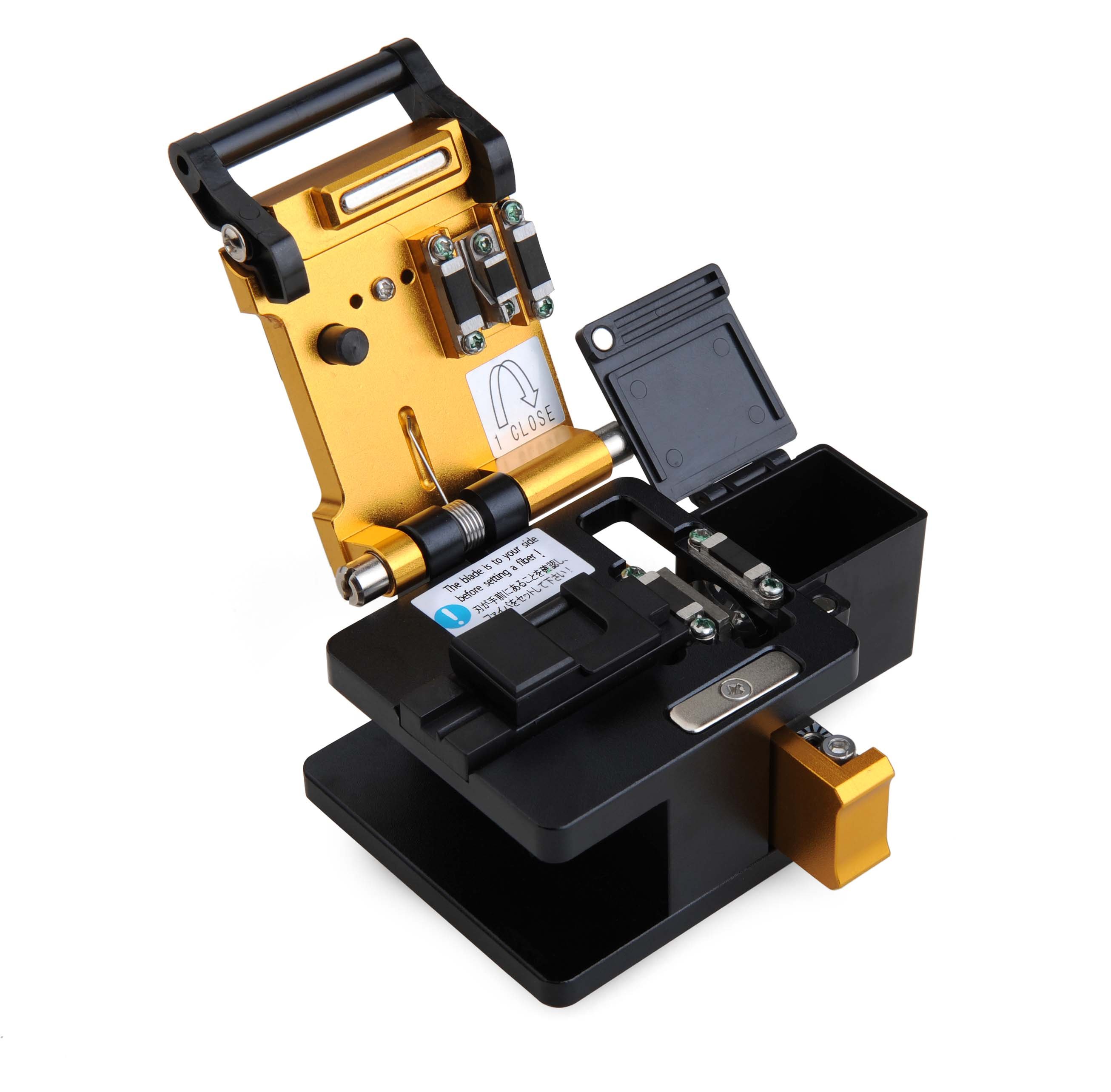
This category represents the industry standard for field work. A precision Fiber Cleaver utilizes automated internal tensioning systems. It features calibrated blade rotation mechanisms. The device consistently delivers an angle variance of less than 0.5 degrees. It remains entirely independent of the operator's physical skill. These tools work best for standard 125/250µm and 125/900µm fusion splicing in active network environments.
Mass production facilities require vastly superior technology. Automated laser systems utilize CO2 lasers operating at 9.3 to 10.6 μm wavelengths. They use absorptive melting rather than mechanical scoring. Alternatively, they use mechanical automated dual-blades.
These systems leave an ultra-low glass profile, typically protruding just 30 to 35 µm above the ferrule. They deliver completely flat cuts. This flat cut eliminates the notorious "concave" defect frequently seen in multi-fiber (MT) scenarios. Factory operators prefer these systems for high-volume terminations. Reducing the polishing process from five steps down to just two steps easily justifies the $40K+ capital expenditure.
Network decision-makers need a strict evaluation framework. You must scrutinize several mechanical variables when shortlisting automated tools for your technicians.
Industrial blades degrade over time. Standard industrial benchmarks expect approximately 48,000 cleaves before you must replace the blade entirely. You should carefully verify the presence of a blade rotation automation feature. Automated rotation prevents the blade from wearing out unevenly. It ensures consistent surface scores across thousands of cycles.
Field technicians perform hundreds of terminations daily. Fatigue directly causes operational errors. Look closely for one-step operation features. Auto-returning slides save significant time. Synchronized lid-closure mechanisms eliminate redundant hand movements. These ergonomic features drastically reduce field technician fatigue. They simultaneously lower the cycle time per splice.
Your networks likely utilize multiple cable types. Ensure your shortlisted tool includes 3-in-1 universal fiber holders. These holders must comfortably handle 0.25mm to 3.0mm jacketed fibers. Versatile holders eliminate the need for frustrating adapter swaps in the field. This saves valuable minutes during every individual splice.
Outside plant environments are brutal on sensitive equipment. Field tools routinely suffer drops, moisture exposure, and dust ingress. Your chosen tool must feature a shockproof housing. Insist on dustproof and waterproof aluminum alloy construction. Plastic housings warp over time and misalign the tensioning sled.
Even the most expensive, highly calibrated tool fails if operators ignore preparation and safety protocols. Field execution demands strict adherence to Health, Safety, and Environment (HSE) standards.
Proper glass preparation requires high-purity chemicals. Technicians use >91% Isopropyl Alcohol (IPA) to aggressively remove all coating residue before the scribe. You must understand the inherent chemical risks. This liquid has a dangerously low flash point of just 73°F. It poses a severe flammability risk in hot climates. Furthermore, vapor pooling presents a severe respiratory hazard when technicians work inside confined spaces like splicing tents or underground vaults.
Cleaved fiber waste presents a unique physical danger. The shards are incredibly sharp. They are also largely invisible to the naked eye. They easily penetrate human skin and travel through the bloodstream.
Tool Mitigation: You should explicitly require tools featuring built-in, large-capacity automatic scrap collectors. These bins physically catch the shards immediately after the fracture propagates.
Field Mitigation: Technicians must use precision tweezers to handle rogue shards. Implement the proven "loop of tape" method. Keep a loop of sticky tape attached to the workbench. Technicians can press invisible shards onto the tape for safe, manual shard containment. This practice prevents devastating skin punctures.
You possess the technical knowledge to evaluate these specialized instruments. Now, you must translate this knowledge into a strategic purchasing decision.
You must balance the upfront equipment cost directly against your projected volume of network terminations. A $1,000 precision model quickly pays for itself in the field. It drastically reduces expensive truck rolls caused by bad splices. In factory settings, an automated laser system pays for itself rapidly. Saving 30 seconds of intensive polishing time per connector transforms your factory output. Higher initial capital dramatically lowers your ongoing operational friction.
Do not simply order a generic tool. Define your exact fiber profiles first. Document whether you terminate single-mode, multi-mode, or specialized MT ferrules. Next, match those profiles to your strict angle tolerance requirement. Most networks require a <0.5° variance. Compile these specific parameters before submitting a formal Request for Quotation (RFQ) to a vendor.
You now understand the fundamental physics of network termination. A Fiber Cleaver remains a highly specialized stress-fracture instrument. It is absolutely not a simple cutting blade. It relies on precise longitudinal tension, microscopic scoring, and controlled sound-speed fracture propagation.
Investing in automated precision directly correlates to superior network performance. Better tools guarantee lower insertion loss metrics. They prevent shattered ferrules and drastically reduce catastrophic field failures. By implementing strict safety protocols and standardizing your equipment, you will build highly scalable and reliable termination workflows for years to come.
Audit your current field tools to check for worn out, high-hackle blades.
Implement the "loop of tape" method and 91% IPA standard across all your active technician crews.
Determine your daily termination volume to justify upgrading to automated mechanical systems.
Require 3-in-1 universal holders for any future equipment procurements to streamline field operations.
A: A physical lip usually indicates a severe tension imbalance or an incorrect blade height. When the tool applies insufficient tension, the crack propagation wanders rather than snapping cleanly. You should immediately adjust the blade height or replace the clamping pads. Worn pads fail to grip the glass securely, allowing it to slip during the scribe.
A: Standard industrial benchmarks dictate that a high-quality rotating blade lasts for roughly 48,000 cleaves. The circular blade features multiple numbered positions. When one position degrades, you simply rotate it to the next sharp notch. You only replace the blade assembly once all positions are dull.
A: We strongly discourage using manual scribes for fusion splicing. Manual pens rely entirely on human force, which is unpredictable. This inconsistency creates severe hackle and mist zones on the glass. These rough surfaces scatter light and virtually guarantee an unacceptable splice loss in active networks.
A: A mechanical tool uses a physical hard blade to score the glass while pulling it apart. A laser tool uses a focused CO2 laser for thermal fracture and absorptive melting. Lasers leave an ultra-low retention height (30-35 µm) above the ferrule, entirely eliminating multiple mechanical polishing steps in factory environments.