Views: 0 Author: Site Editor Publish Time: 2026-09-24 Origin: Site
Fiber networks are expanding at a blistering pace as we move deeper into 2026. For technicians tasked with building this critical infrastructure, a reliable splicing tool is no longer just an option. It is the absolute lifeline of their daily operations. Choosing the right machine, however, often feels overwhelming. Buyers are constantly bombarded with a dizzying array of complex technical specifications and fluctuating price points. We need to cut through the noise. In this guide, we break down alignment types, essential field features, and overall return on investment to help you make a confident, data-driven decision based on real-world engineering standards.
Alignment Matters: The most critical decision in your purchasing process is selecting between Core Alignment, Cladding Alignment, and Ribbon variants. Each serves a distinct network architecture.
Speed and Efficiency: Field efficiency is paramount. Top-tier machines should consistently deliver splice times under 6 seconds and heating times under 15 seconds to minimize expensive labor costs.
Durability is Non-Negotiable: Technicians operate in unpredictable, harsh environments. Prioritizing equipment with high Ingress Protection ratings for dust, water, and shock resistance ensures operational stability.
Total Cost of Ownership: Objective procurement requires looking far beyond the initial purchase price. Factoring in electrode lifespan, routine maintenance, and rework costs provides a true measure of your investment.
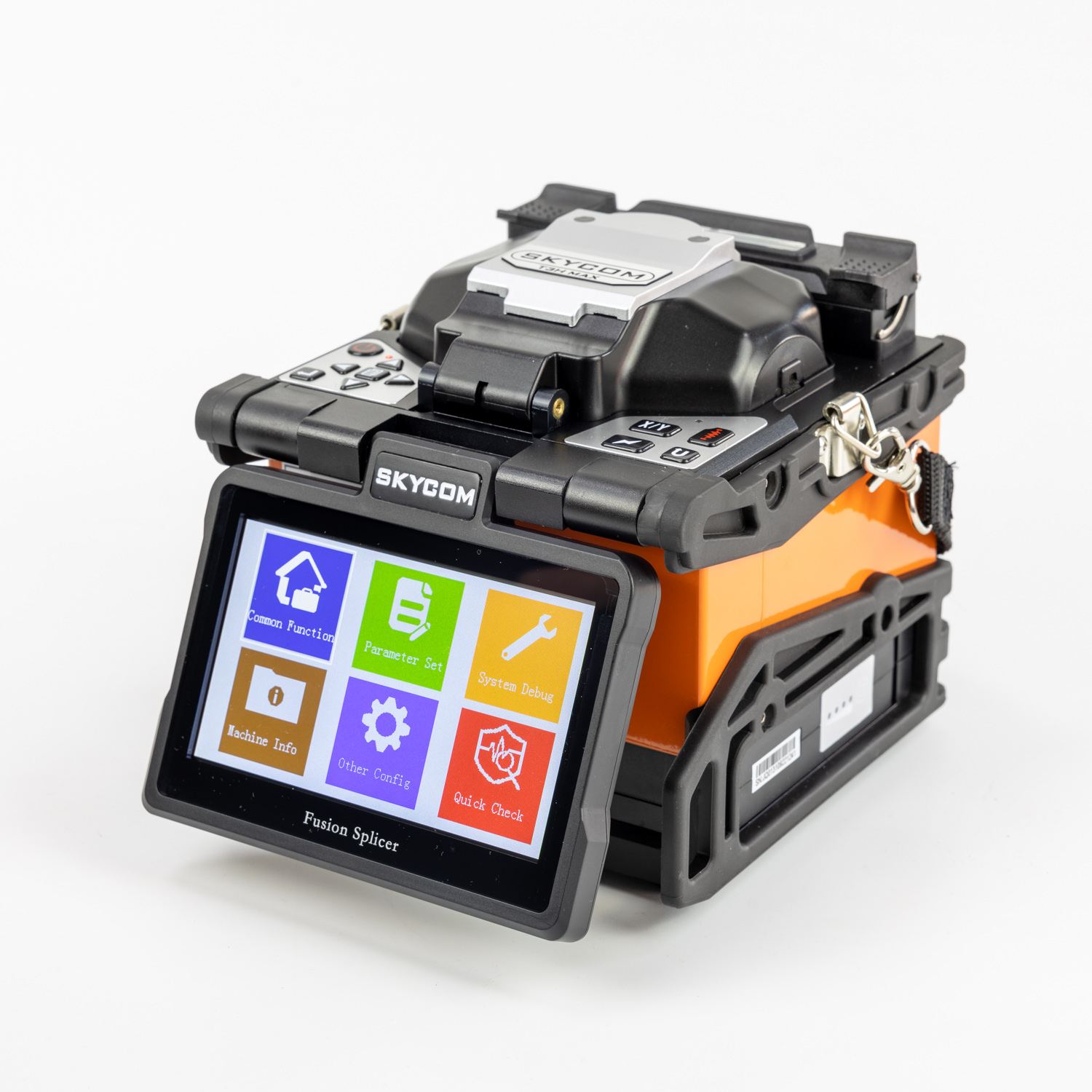
Top Pick for 2026: Devices like the Skycom T3H stand out by balancing high-precision core alignment technology with rugged durability, establishing an optimal standard for modern fiber projects.
Picture a field engineer working in a cramped underground vault or suspended in a bucket truck against freezing winds. In these demanding scenarios, they rely on a highly specialized electromechanical instrument to seamlessly join two optical fibers end-to-end. Investing in a professional-grade Fusion Splicer ensures that a localized electric arc melts the silica glass with absolute precision. When executed correctly, this process produces a continuous optical path that allows light signals to pass through with near-zero reflection.
Looking closely at the telecommunications landscape in 2026, industry analysis reveals a massive shift toward hyper-connectivity. The aggressive rollout of dense 5G networks, alongside the foundational groundwork for early 6G testing, demands unprecedented reliability. Furthermore, the exponential expansion of hyperscale AI data centers requires bandwidth capacities that leave zero room for error. Optical loss budgets are shrinking rapidly. Network operators increasingly mandate automated, high-precision tools to keep up with accelerated deployment schedules.
In these high-stakes environments, even a microscopic misalignment causing a fraction of a decibel in signal loss can trigger network latency, packet drops, or costly maintenance truck rolls. High-precision splicing is no longer a luxury. It is a strict technical requirement to meet the stringent optical standards defined by today's global network architects. This guide is specifically engineered for telecom contractors, data center engineers, and procurement managers who need objective data to make informed equipment investments.
Understanding the mechanical nuances of fiber alignment is the absolute foundation of your procurement process. The industry categorizes these devices into three primary types. Each is engineered for specific operational environments and fiber counts.
Technology Type | Alignment Method | Ideal Application | Typical Splice Loss |
|---|---|---|---|
Core Alignment | 6-motor Profile Alignment System viewing the inner core | Long-haul networks, 5G backhaul, single-mode fibers | Less than 0.02dB |
Cladding Alignment | 4-motor V-groove system aligning the outer glass shell | Short-distance FTTH, LAN, multimode fibers | Around 0.05dB |
Ribbon Splicer | Mass V-groove alignment for multiple fibers at once | High-density data centers, major metro backbones | Varies by fiber count |
Core alignment represents the pinnacle of splicing precision. Rather than merely looking at the glass exterior, these machines utilize a Profile Alignment System powered by six separate stepper motors and multiple high-resolution cameras. They peer directly into the light-carrying inner core. Specifically, the motors adjust the fibers on the X, Y, and Z axes to ensure the cores match perfectly. This effectively neutralizes any slight asymmetrical flaws or concentricity errors originating from the fiber manufacturing process. It is the mandatory standard for single-mode fibers and dense wavelength-division multiplexing systems.
Cladding alignment models rely on a much simpler mechanical design. These devices typically use four motors and align the fibers based on their outer diameter. The fibers sit in a fixed V-shaped groove before the machine brings them together. Because this method assumes the core is perfectly centered within the cladding, any manufacturing imperfections in the glass can result in slightly higher splice loss compared to core alignment. They remain a viable choice for budget-conscious projects where a slightly higher loss remains acceptable.
Ribbon variants are designed purely for volume and density. Instead of processing a single fiber at a time, these robust machines can splice entire ribbons containing up to 12 or 24 fibers simultaneously in a single arc cycle. They utilize advanced cladding alignment within precision-machined V-grooves to handle the mass splice smoothly, making them ideal for high-density data center interconnects.
Once the appropriate alignment type is determined, evaluating the technical specifications becomes the next critical step. When evaluating a modern fiber optic fusion splicer, baseline standards have shifted significantly. Older legacy specifications are no longer sufficient for competitive field operations.
Labor consistently remains the highest variable cost in any fiber deployment project. Consequently, the operational speed of your equipment directly impacts profitability. Imagine a technician performing aerial work in harsh weather. A machine that cuts heating time down means less exposure to the elements and faster project completion. The current industry standard for a premium device requires a splice time of 6 seconds. Equally important is the tube heating cycle. Modern machines must feature rapid heating ovens that shrink the protective sleeve in just 15 seconds. Saving 20 seconds per splice translates into hundreds of labor hours saved over a large-scale FTTH rollout.
The ultimate metric of a successful joint is the attenuation it introduces into the network. For standard single-mode fiber, the acceptable industry standard for splice loss must consistently stay below 0.02dB. Beyond simple loss, buyers should look for empirical data regarding return loss, which should ideally exceed 60dB to prevent back-reflection issues in high-power optical systems.
Field technicians frequently find themselves in remote locations miles away from grid power. A robust lithium-ion battery is therefore essential. Current engineering guidelines dictate that a high-quality machine must feature at least a 5200mAh battery. This capacity comfortably supports 200 continuous splice-and-heat cycles on a single charge, covering a grueling 8-hour shift. Physical footprint matters just as much. The unit should ideally weigh under 2.5 kg including the battery, without compromising its stabilizing base.
Telecommunications gear is subjected to harsh environmental realities daily. Procurement teams must mandate machines with verified Ingress Protection ratings. An IP52 rating or higher ensures the internal optics and sensitive motors remain protected from wind-blown dust and unexpected rain. Standard drop-test certifications ensure that an accidental slip in the mud does not result in catastrophic equipment failure.
The evolution of optical equipment has integrated significant software and interface upgrades. These tools have transformed from purely mechanical hardware into smart, data-driven devices.
Precision work demands flawless visibility. Modern units come equipped with advanced CMOS cameras and powerful magnification capabilities. A standard 2026 machine offers at least 300x magnification on the X or Y axis, displayed on a high-definition, anti-glare LCD screen. The seamless integration of capacitive touchscreens allows technicians to navigate menus, adjust arc parameters, and zoom in on fiber cores with intuitive gestures. This drastically reduces the training curve for new operators.
Automation effectively neutralizes human error. Features such as auto-start splicing streamline the entire workflow by automatically closing the wind cover and initiating the arc the moment a fiber is detected. In addition, onboard environmental sensors now automatically calibrate the electric arc based on real-time temperature, humidity, and atmospheric pressure. For comprehensive project management, these devices feature internal storage for up to 10,000 splice records.
Procurement decisions driven solely by the lowest initial price tag almost always backfire. Evaluating the Total Cost of Ownership is the only objective way to assess the true value of a high-quality fusion splicer over its operational lifespan.
Budget-tier models often advertise incredibly low upfront costs but frequently suffer from inconsistent arc discharges and poor core alignment algorithms. This unreliability leads to high splice failure rates. In modern FTTH or 5G deployments, a failed splice means a technician must cut the fiber, strip it, clean it, cleave it, and splice it all over again. If a technician performing 100 splices a day experiences a 10 percent failure rate due to subpar equipment, the labor costs associated with that rework will quickly eclipse any money saved initially. Investing in a reliable machine pays for itself through increased daily productivity.
To fully protect your investment, you must factor in consumable components. Electrodes are the most critical consumable, as they generate the electrical arc that melts the glass. Over time, silica buildup and thermal degradation cause the arc to become unstable. Professional machines should yield between 4,000 and 5,000 arcs before requiring replacement. Verify the availability of local customer support to avoid unacceptable downtime costs.
Navigating the current market requires balancing advanced technical specifications with practical field usability and realistic budgets. Technicians need a device that offers true high-precision alignment, rapid operational speeds, and rugged durability.
Based on strict engineering criteria of precision, durability, and cost-to-performance ratio, one of the most compelling options for network technicians this year is the Skycom T3H Fusion Splicer. This model is meticulously engineered to bridge the gap between premium optical performance and accessible pricing. It stands as a highly logical choice for both independent contractors and large-scale telecom operators.
The T3H utilizes a state-of-the-art 6-motor core alignment system. By employing high-resolution cameras with 300x magnification to identify the exact center of the fiber core, it consistently achieves ultra-low splice losses well below 0.02dB for single-mode fiber. It directly addresses the need for field efficiency by delivering a rapid splice time of just 6 seconds, paired with an accelerated 15-second tube heating cycle.
Furthermore, this machine is built for the unforgiving realities of outside plant environments. It features a reinforced, shock-proof chassis with robust resistance against dust and moisture. Powered by a high-capacity 5200mAh lithium battery, it easily supports over 200 continuous splice and heat cycles without the need for mid-shift recharging. By offering premium capabilities without an inflated price tag, it delivers an exceptional return on investment.
A high-end machine is only one part of the equation. The quality of a fiber optic joint is heavily dependent on the preparation of the fiber before it ever enters the V-groove. To achieve zero-defect splices, technicians must utilize professional-grade preparation tools.
The golden rule of fiber optics is undeniable: your weld is only as good as your cleave. The distinct snap of a perfectly cleaved fiber sets the stage for a zero-loss joint. When you strip the protective coating off an optical fiber, the exposed glass must be cut at an exact 90-degree angle. If the angle is off by even one degree, the machine will reject the fiber or produce a high-loss splice. Investing in a high-precision, automatic blade-rotation fiber cleaver is mandatory. High-quality calibrated strippers are also required to remove the outer coating without micro-scratching the delicate glass cladding beneath.
Contamination is the primary enemy of optical networks. Microscopic dust particles, skin oils, or morning dew will drastically alter the trajectory of the electrical arc and cause bubbles inside the melted glass. A professional kit must include specialized optical-grade lint-free wipes and strictly 99 percent pure isopropyl alcohol. Standard rubbing alcohol contains water, which leaves a detrimental residue on the glass. Finally, high-quality heat shrink protection sleeves containing a stainless-steel reinforcement rod are essential to ensure the mechanical integrity of the splice.
Under normal field conditions and with proper maintenance, a professional-grade unit can last between 5 to 10 years. The longevity depends heavily on the operating environment, how frequently it is subjected to physical shocks, and whether the user adheres to strict cleaning protocols. Regular servicing and keeping the V-grooves free of silica debris will significantly extend the hardware's lifespan.
The standard replacement interval for electrodes is between 3,000 and 5,000 arc discharges, depending on the manufacturer's exact specifications. Modern devices feature built-in counters that will alert you when the tungsten rods are nearing the end of their life. Operating with worn electrodes results in an unstable arc, causing weak joints and high attenuation. Always use genuine manufacturer-approved replacements.
Yes, but it is strictly recommended only for short-distance applications, such as FTTH drop cables or short local area networks. Cladding alignment relies on the physical exterior of the fiber. Because the core of a single-mode fiber is incredibly small, any slight manufacturing imperfection in the fiber's concentricity will cause misalignment. For long-haul single-mode networks, core alignment is mandatory to prevent unacceptable signal degradation.
High splice loss is rarely a failure of the machine itself. It is usually an issue with fiber preparation. The most common culprits include a poor cleave angle caused by a dull blade, microscopic dust or oil left on the fiber due to improper cleaning, worn-out electrodes producing an inconsistent arc, or debris trapped in the machine's V-grooves preventing the fibers from sitting perfectly flat.
For modern 5G backhaul and hyperscale data center links, the tolerance for signal degradation is extremely strict. The industry standard dictates that splice loss for single-mode fiber must not exceed 0.02dB per joint. Consistently exceeding this threshold can lead to cumulative signal attenuation, ultimately causing network latency or total link failure.
Absolutely. High humidity can introduce moisture to the glass, causing bubbles during the arc discharge, while extreme cold can affect battery voltage and mechanical alignment speeds. This is why modern units incorporate built-in environmental sensors that automatically adjust the arc power and duration based on real-time temperature and atmospheric pressure to maintain consistent weld quality.
Choosing the right equipment requires careful research and a clear understanding of your specific network architecture. By balancing speed, alignment precision, and environmental durability, you ensure your network performs flawlessly for decades to come. Reliable tools not only boost daily efficiency but safeguard the integrity of the entire optical infrastructure. Evaluate your field requirements, prioritize core alignment for critical links, and equip your team with technology built for the future. For detailed specifications and to find the perfect splicing solution tailored to your operational needs, explore the professional lineup at Skycom today.